
Office of the Treaty Commissioner and Regina Public Schools sign MOU on Treaty Education
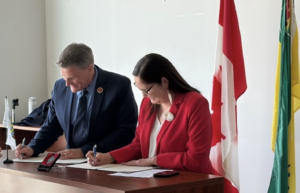
The Office of the Treaty Commissioner (OTC) and the Regina Public School Division (RPSD) signed a Memorandum of Understanding this morning at the mâmawêyatitân centre, located at Scott Collegiate.
The MOU is aimed at enhancing collaboration and support between RPSD and the OTC that will promote Treaty education and Treaty Rights and Responsibilities through the implementation of the Treaty Outcomes of the Saskatchewan Ministry of Education. It also enables ongoing collaboration to help guide RPSD’s strategic plan as it pertains to the inclusion of Indigenous concepts, history, culture, community and inclusion of Indigenous narratives and perspectives.
“Regina Public Schools is committed to recognizing and honouring the Indigenous Peoples of Saskatchewan’s Treaty Nations, and a critical part of this is in the classroom,” said Mark Haarmann, Director of Education and CEO at Regina Public School Division. “We are grateful for our time engaging with the Office of the Treaty Commissioner and look forward to deeper collaboration on enhancing Indigenous and Treaty education in our schools. We are all Treaty people.”
Good for five years, the MOU will enable the creation of shared education projects that promote understanding on Treaties as well as the United Nations Declaration on the Rights of Indigenous Peoples, Canada’s Truth and Reconciliation Commission Calls to Action, and the Missing and Murdered Indigenous Women and Girls Calls to Justice. Part of these projects include exhibits at RPSD museum locations, special off-site exhibits, and traveling exhibits, whenever feasible.
“The concrete actions being taken to implement Treaty education are for our children and future generations—so they may understand the truth of our shared history,” said Dr. Kathy Walker, Treaty Commissioner of Saskatchewan. “By creating a partnership with Regina Public Schools, we are strengthening opportunities for students, educators, and communities to learn what it means to live the Treaties. By understanding our shared history and what it means to be a Treaty person, we can create a stronger future for everyone.”
Both parties will meet annually to review progress made, discuss opportunities for improvement, and ways to deepen education around Treaty Rights and Indigenous culture, history, and more.